
TechNet executives are meeting with senior Obama Administration officials and an array of bipartisan Congressional leaders to advocate for a robust innovation policy agenda.

The next generation GST reforms would 'absolutely' set an economy open and transparent with further reduction in compliance burden and benefiting small businesses, Union Finance Minister Nirmala Sitharaman said on Tuesday.

Ahead of the Budget, Finance Minister Arun Jaitley on Tuesday underlined the need for tax reforms and quick decision making to ensure stability in policy regime.

The government has no say in where the country's refiners source oil from because these are commercial transactions.

GST Reform 2.0, which trims tax slabs from four to two, signals a push for demand-led growth, and together with recent income tax cuts, sets the stage for sustained economic growth, experts said. The Goods and Services Tax (GST) Council on September 3 approved an overhaul of the indirect tax regime by taxing essentials at 5 per cent and other goods at 18 per cent. A new 40 per cent tax will be applicable on luxury and sin items.

The GST Council on Wednesday approved a two-tier rate structure of 5 and 18 per cent, which will be implemented from September 22.

Shares of tyre manufacturers have outperformed broader equity benchmarks, buoyed by multiple tailwinds. Softer raw material prices, an uptick in demand from automakers following the reduction of the goods and services tax (GST) rates, and steady replacement demand have lifted sentiment toward the sector.

Driven by GST reforms, robust festive demand, and softening raw material prices, the FMCG industry expects volume-based growth, supported by a mid-single digit revenue rise and improved operating margins in the December quarter.

The contrast with the old Income-Tax Act is stark. The 1961 law ran into 512,000 words; the 2025 one pares that down to 259,000. Chapters have been cut from 47 to 23, while sections have reduced from 819 to 536. One of the clearest changes is terminological. The confusing twin concepts of 'assessment year' and 'previous year' have been scrapped.

The Indian government has expressed its disagreement with the IMF staff's 'baseline' assumption that the 50 per cent US tariffs on its goods exports 'would remain in place indefinitely', based on which the staff pegged the country's GDP growth at 6.6 per cent this year, and pared its 2026-27 projection by 20 basis points to 6.2 per cent.

After a year of modest returns, equity investors may anticipate gains of 10-15 per cent in Samvat 2082, which began on October 21. Although valuations have moderated from their peaks a year earlier, they remain above long-term averages, potentially limiting sharp upsides.
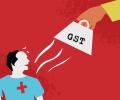
Reduction of GST on health insurance premium from 18% to 0% looks like a straight 18% reduction in what consumers pay. The truth, however, is...
Fitch Ratings on Thursday raised India's GDP growth forecast for the current fiscal to 7.4 per cent, from 6.9 per cent, on increased consumer spending and improved sentiment boosted by GST reforms.

Amid US-China trade tensions and economic vulnerabilities, India must seize the 'China +1' opportunity, deepen reforms, secure FTAs, and globalise its firms for long-term growth, suggests Ajay Shah.

One of India Inc's top demands is the abolishing of the MAT.

The government is finalising a major GST overhaul with automated refunds, pre-filled returns, and analytics-based scrutiny to simplify compliance and boost liquidity for MSMEs.

The government has proposed to replace the Income Tax Act of 1961 with a direct taxes code, which would simplify the legislation.
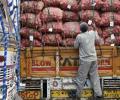
India's existing web of federal and state sales taxes is levied at different stages of the supply chain and often results in double taxation, while forcing trucks to spend nearly a quarter of their road time in border checks or other inspections.

To digitise Customs processes, the Union finance ministry is planning to integrate the Indian Customs Electronic Gateway (ICEGATE), Risk Management System (RMS), and Indian Customs Electronic Data Interchange System (ICES) into a single unified national Customs platform, according to government sources.


Well-known inmates of the notorious Metropolitan Detention Center, Brooklyn, New York.
India's real gross domestic product (GDP) is likely to grow at 7.5 per cent in FY26 and moderate to 7 per cent in the subsequent fiscal year, a domestic rating agency said on Wednesday.

Jaitley said a very large number of reforms have taken place over the last few years and that has helped in restoring the credibility of the Indian economy

The Trump trade shock is a chance to push long-overdue reforms, rather than tinker with tariffs to appease the US, suggests M Govinda Rao.

Nearly 96 per cent of new applicants will benefit from this simplified approval route.

Festive buying spree unleashed by lower tax rates pushed gross GST collection to about Rs 1.96 lakh crore in October, registering a 4.6 per cent year-on-year growth -- the slowest rate so far this fiscal.

Three laws passed in Parliament could boost central revenues, reshape GST cess flows, shift MGNREGA costs to states and create new budget headroom ahead of the 2026-2027 Union Budget, points out A K Bhattacharya.

"The new structure will substantially reduce taxes on the middle class and leave more money in their hands, boosting household consumption, savings and investment," Sitharaman said presenting what was dubbed as 'reformist' budget for the next fiscal in Lok Sabha.

After a record-breaking year, India's automobile industry is entering 2026 on a relatively strong footing, with sales growth expected in the 6-8 per cent range. The outlook is underpinned by policy support, including GST rationalisation, easing monetary conditions, and income tax relief, which together are likely to improve affordability and sustain consumer demand across vehicle segments.

'The market is still very bullish. The demand is so strong that for eight models, we have no units in our factories to dispatch to dealers,' said Partho Banerjee, senior executive officer, marketing & sales, Maruti Suzuki India (MSIL).

India's luxury auto market is rebounding after a slow start to 2025, with GST 2.0 emerging as the main catalyst.
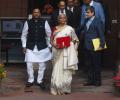
Finance Minister Nirmala Sitharaman on Saturday unveiled 'transformative' tax reforms that ranged from a simpler income tax law to higher TCS threshold for remittances and income tax benefits for middle class.

After a subdued first quarter of 2025-26 (Q1FY26), banks are now betting big on the festive season, rolling out attractive loan offers to boost credit growth in the second half of the current financial year (H2FY26) - a trend likely to be further accentuated by the second-order effects of the good services tax (GST) cuts.

The exemption of individual life and health insurance premiums from the Goods and Services Tax (GST) enables the insurance industry to make products affordable and attractive, said Ajay Seth, chairman of Insurance Regulatory and Development Authority of India (Irdai) at the Business Standard BFSI Insight Summit 2025.

The latest move removes one of the key friction points for visitors, temporary liquor permits, while allowing licensed hotels and restaurants operational flexibility.

India's manufacturing sector activity strengthened in October, buoyed by Goods and Services Tax relief, productivity gains and tech investment, even as international sales rose at a weaker pace, a monthly survey said on Monday.

Auto majors Maruti Suzuki, Tata Motors and Mahindra & Mahindra reported robust sales in September as reduced price tags owing to GST rationalisation led to record demand in the Navaratri period. The month also saw Tata Motors and Mahindra & Mahindra settling at number two and three positions, respectively in vehicle wholesales ahead of Hyundai Motor India.

Festivals also contribute to the rise in overall automobile retail sales, says dealers association.

Following Axis Max Life Insurance's second-quarter results for 2025-26, Sumit Madan, managing director and chief executive officer of the company, speaks to Aathira Varier and Subrata Panda/Business Standard about growth aspirations, strategies to offset the impact of the input tax credit (ITC) withdrawal, reverse merger plans, and more.
These changes certainly bring India's GST a lot closer to what an ideal GST would look like, points out Karan Bhasin.
 © 2026 Rediff.com - Advertise with us - Disclaimer - Privacy Policy - Sitemap - Feedback - About us - Terms of use - Grievances